Purpose: How concentration can affect the performance rate of disinfectants in killing micro-organisms
Savlon
What is a disinfectant?
- bacteriacidal
What does it do?
- inhibits the growth of bacteria
Why does it do that?
- cetrimide
- chlorhexidine gluconate
Structure of a cell
Binary Fission - reproduction
Aim: I want to investigate how to kill bacteria using different concentration of Savlon.
Hypothesis: I think that the higher the concentration of Savlon the more bacteria killed.
Variables:
What is your independent variable? The concentration of savlon
What is your dependant variable? The clear zone
Describe a suitable range of values to be used for the independent
variable and how these values will be changed? The range of the concentrations i used were 0, 1/10, 1/100, 1/1000
Describe how the dependent variable will be measured and give its units? we measured the diameter of the clear zone with a ruler in millimetres
Identify any other variables that might influence your investigation and
describe how they will be controlled or kept the same to make your results
more accurate? A variable that could influence the investigation is the size of the filter paper disks, we ensured that they were keep the same size by using a hole punch. Another variable is the fact that we used savlon for the investigation instead of detol, we used salvlon because it tested better and another variable is the temperature that the agar plates were kept at, we controlled this by putting them in an incubator.
Describe how you will ensure that your results are reliable and that you
have enough data? I ensured that my data was reliable because we did the experiment three times and took an average, we also removed an outlier.
Equipment:
- Agar Plate
- Vivid
- Yoghurt
- Cotton Bud
- Discs of filter paper - hole punched
- Tweezers
- Ethanol - alcohol
- Bunsen Burner
- Pipette - Dropper
- Dimple Tray
Method:
1. Label the agar plate into quarters.
2.Pour some of the diluted yoghurt into the agar plate
4.Use a paper towel to soak up the unwanted yoghurt left on the rim of the agar plate
5.Use a pipette to do the dilutions on a spotting tile
6.Clean the pipette after each dilution
-10 drops of savlon, (0)
-9 drops of water, 1 drop of savlon, (1/10)
-9 drops of water, 1 drop from the solution above, (1/100)
-9 drops of water, 1 drop from the solution above, (1/1000)
7. Hole punch the filter paper into 4 small discs x3
8. Dip tweezers in ethanol
9. make sure to put the lid back on the ethanol each time
10. pass the tweezers through the flame to make sterile
11. use the tweezers to pick up the filter paper circles
12.soak the filter paper circles in each of the different concentrations
13. place the filter paper that was soaked in the different concentrations of savlon into the quarters of the agar plate
14. tape the agar plate closed
15. label with your initials
16.leave overnight

Trend Line

This data showed
- That the line is increasing
My conclusion
- My hypothesis was correct, I conclude that the higher the concentration of savlon used the more bacteria is killed, therefore the clear zone is bigger.
Discussion
The purpose of the Savlon was to stop the growth and reproduction of the bacteria. Bacteria are very small microorganism's, which have cell walls. For example the Capsule is the outer layer, cell wall is the middle layer and the cell membrane is the inner layer. Savlon kills bacteria because it contains Cetrimide and Chlorhexidine Gluconate. These layers protect, keep the structure and the cell membrane controls what enters and exits the cell. The chemical in Savlon is Chlorhexidine and it is bactericidal and bacteriostatic and kills bacteria by breaking down the cell membrane.
Structure

Reproduction of bacteria
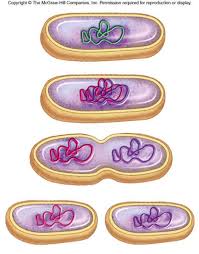 1. Cell replicates it's DNA
2. The cytoplasmic membrane gets bigger, separating DNA molecules.
3. Membrane closes in, a cross wall is formed
4. Daughter cells.
The Chlorhexidine in savlon affected the structure of the bacteria so they were no longer able to reproduce, which is why they created the clear zones in the agar plates.
Growth
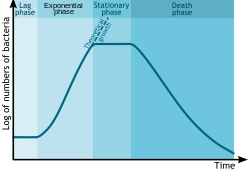
Phase 1: Lag Phase
Bacteria begin to take in nutrients, synthesize, their RNA and there proteins, but they are not ready to replicate/reproduce yet.
Phase 2: Exponential Phase
Bacteria replicate quickly.
Phase 3: Stationary Phase
Bacteria death rate and growth rate are the same.
Phase 4. Death Phase
Nutrients are no longer available so the bacteria dies
Evaluation
If something went wrong, what was it and how did you fix it? On one of the agar plates we spread the yoghurt to thin so it left a patch, we didnt use this measurement because it would effect the overall result.
Were there any anomalies? We had one outlier from when we spread the yogurt to thin.
What were some of the problems and how could you fix them in the future? We struggled getting all the agar plates finished before the period ended, so some of the yogurt didn't set properly, we could have started the investigation earlier in the period.
Has your investigation raised any challenging questions? Is there any way possible that we could speed the process up
Discussion
The purpose of the Savlon was to stop the growth and reproduction of the bacteria. Bacteria are very small microorganism's, which have cell walls. For example the Capsule is the outer layer, cell wall is the middle layer and the cell membrane is the inner layer. Savlon kills bacteria because it contains Cetrimide and Chlorhexidine Gluconate. These layers protect, keep the structure and the cell membrane controls what enters and exits the cell. The chemical in Savlon is Chlorhexidine and it is bactericidal and bacteriostatic and kills bacteria by breaking down the cell membrane.
Structure

Reproduction of bacteria
2. The cytoplasmic membrane gets bigger, separating DNA molecules.
3. Membrane closes in, a cross wall is formed
4. Daughter cells.
The Chlorhexidine in savlon affected the structure of the bacteria so they were no longer able to reproduce, which is why they created the clear zones in the agar plates.
Growth
Phase 1: Lag Phase
Bacteria begin to take in nutrients, synthesize, their RNA and there proteins, but they are not ready to replicate/reproduce yet.
Phase 2: Exponential Phase
Bacteria replicate quickly.
Phase 3: Stationary Phase
Bacteria death rate and growth rate are the same.
Phase 4. Death Phase
Nutrients are no longer available so the bacteria dies
Evaluation
If something went wrong, what was it and how did you fix it? On one of the agar plates we spread the yoghurt to thin so it left a patch, we didnt use this measurement because it would effect the overall result.
Were there any anomalies? We had one outlier from when we spread the yogurt to thin.
What were some of the problems and how could you fix them in the future? We struggled getting all the agar plates finished before the period ended, so some of the yogurt didn't set properly, we could have started the investigation earlier in the period.
Has your investigation raised any challenging questions? Is there any way possible that we could speed the process up

Hi Gemma,
ReplyDeleteYou have made a really good start so far but here are some things to think about to improve it further.
In your method, would someone be able to do the dilutions?
You will need to research Savlon and it's active ingredient as this may be different to Dettol.
Your graph and table are very good - you should be able to write some good discussion points about this for Merit and Excellence.
Miss Huddleston